

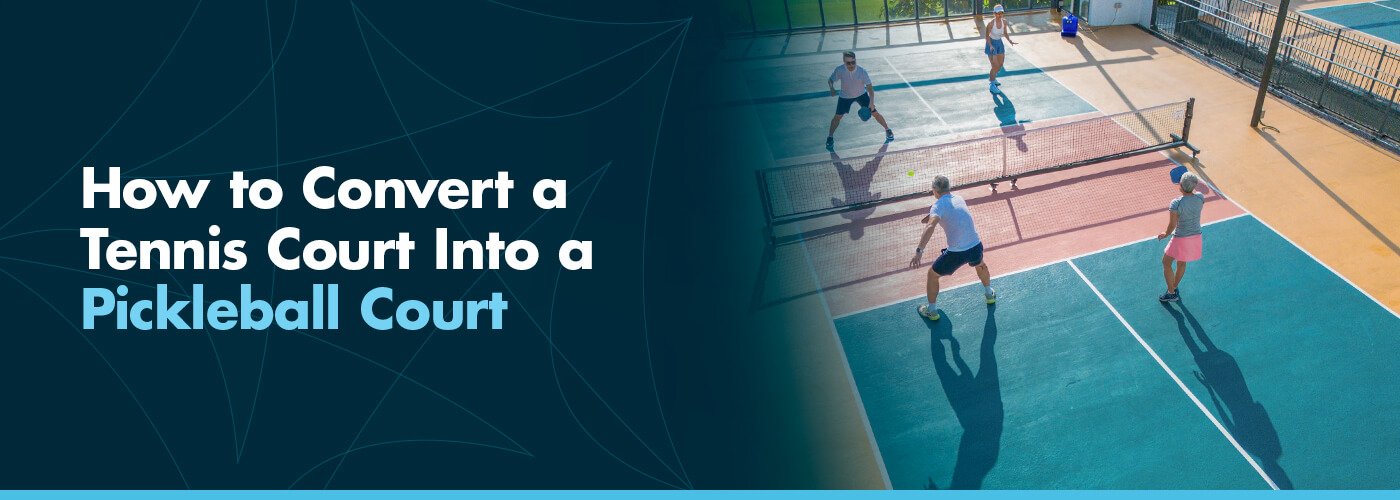
Pickleball has exploded in popularity over the past few years. By the end of 2024, there were almost 16,000 pickleball courts across the U.S., and the once-niche game is now considered the fastest-growing sport in the country. It’s easy to pick up and play with friends while also boasting a robust tournament scene for those who want to compete against other enthusiasts. This popularity has led many commercial tennis court owners to consider transforming their courts into pickleball courts.
Pickleball court conversions can make your space appealing to a whole host of new players and increase the number of people who can use it simultaneously.
Converting a tennis court to pickleball courts involves items like measuring and marking the smaller 20’x44′ pickleball court dimensions on the existing surface using paint, chalk, or tape, lowering the net to 34″ in the center, and installing new net posts and anchors.
The conversion process takes time and precision, and that’s where we come in. Our tennis-to-pickleball court conversion guide will explain the design of each court and the necessary steps to take to optimize the space for pickleball play.
Standard Court Dimensions and Layouts
The typical tennis court adheres to standards set by the International Tennis Federation and the United States Tennis Association. Regulation singles courts measure 78 feet long and 27 feet wide, while regulation doubles courts are a bit bigger, at 36 feet wide. Recreational courts are smaller, typically 60 feet long and 30 feet wide. A total area of 120 feet by 60 feet is recommended.
A standard tennis court will also feature:
- Lines made of paint, chalk or tape.
- A net that extends across the center of the court and measures 42 inches tall at the posts and 36 inches tall in the center.
- A service line that extends between the two singles sidelines 21 feet from the net.
- A center mark that identifies the middle of the baseline without connecting to the service line.
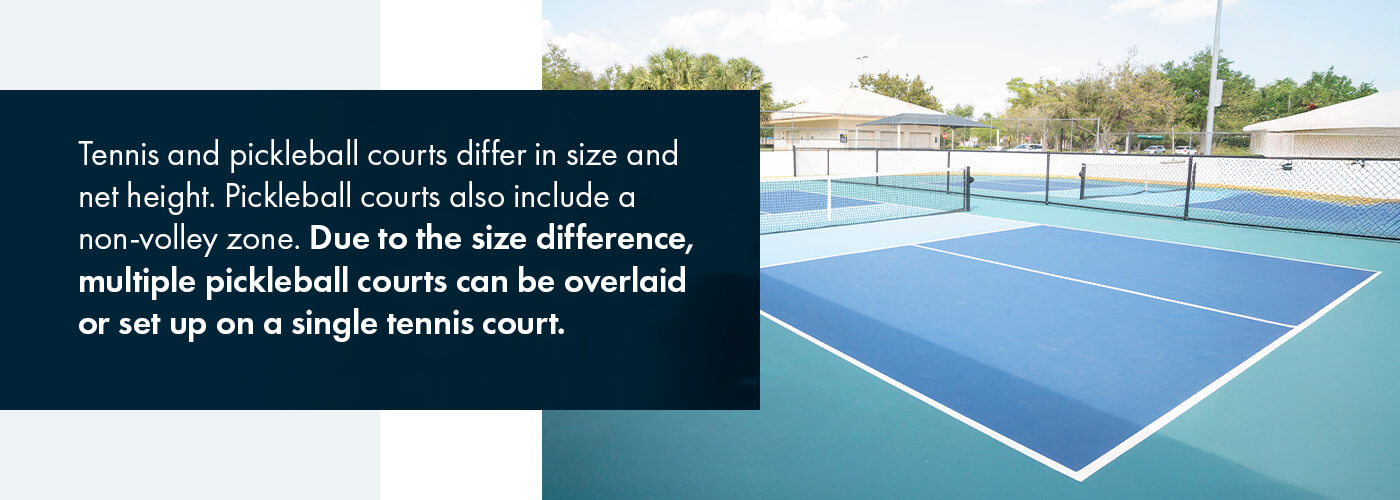
Pickleball courts are a bit different. The standards for these courts are set by USA Pickleball, the National Governing Body for pickleball in the U.S. According to their rules, the full area of play for a pickleball court — including overruns — measures 60 feet long and 30 feet wide. The actual court measures 44 feet long and 20 feet wide.
In addition to lines made of paint, chalk or tape, standard pickleball courts also feature:
- A net that extends across the center of the court and measures 36 inches tall at the sideline and 34 inches tall in the center.
- A non-volley zone that extends 7 feet on either side of the net.
- A centerline connecting the middle of the non-volley zone to the middle of the baseline
Some facilities choose to overlay the two courts atop one another, similar to how volleyball courts are often placed atop basketball courts. Others invest in nets and lines that can be temporarily set up on top of tennis courts. For a more permanent update, facilities can replace the tennis court entirely with pickleball courts. In any scenario, up to four pickleball courts can fit on a single tennis court.
Step-by-Step Tennis Court to Pickleball Court Conversion Guide
Here’s how to convert a tennis court into a pickleball court.
1. Prepare the Surface
Before work begins, crews will clear the play area of dust, dirt and debris to make drawing clean court lines and installing the new equipment easier.
If the tennis court is being permanently converted into four pickleball courts, the tennis net posts will need to be removed to make space. The posts are typically connected to a pipe anchor and a concrete footer or sleeve set into the court surface. In some cases, these sleeves can be filled in. If they cannot, they will likely need to be removed entirely. Once they are extracted, the court will need to be resurfaced to ensure it remains flat and safe to use during play.
Next, installation crews will address any other damage the play area has sustained over time, such as divots, mold and water damage. Keeping the area clean and functional will make the installation process easier and make the courts more appealing to potential users.
2. Measure and Mark the Dimensions
Once the play area is cleared, it is time to begin laying out the court. Whether installing one, two or four courts, the measurements will remain the same. It’s just a matter of where the courts will be positioned:
- One court: Place the new court right where the tennis court used to be.
- Two courts: Place the new courts next to one another on one side of where the tennis net used to be.
- Four courts: Two courts can be placed next to each other on either side of where the tennis net used to be.
Next, crews will measure the exact dimensions and mark them with the material of choice, whether resin, chalk or tape.
3. Install Nets, Posts and Anchors
The final step of a tennis-to-pickleball court conversion is acquiring and installing the nets and the structures that support them. Some court owners may also choose to install new fences around the pickleball courts or upgrade the doors within the fence, but these are optional.
Crews will install new pipe anchors and concrete footers or sleeves that can support the posts and the net. They may need to remark some court lines in the aftermath of the installation.
Additional Equipment and Accessories for Pickleball Courts
Many optional pieces of equipment can improve the pickleball experience for players. Here are some examples:
- Community paddles and balls: Providing pickleball equipment can lower the barrier to entry for new players and lead to more consistent use of your courts. More experienced players may bring their own equipment, which can extend the life of community equipment and decrease the risk of losing it.
- Benches: Players, spectators and court owners can all benefit from benches. For players, they provide a space to rest and catch their breath or keep their equipment. For spectators, they represent a space to sit and watch the game from a comfortable and unique vantage point. For owners, they can turn a casual practice space into a community hot spot, where players and teams invite friends and family to watch games or join in on the fun.
- Basic rules signs: Another way to make the pickleball court more beginner-friendly is to include signage that explains the basic rules of the game. New players may find the rules governing service, scoring and the non-volley zone hard to keep track of. The signage can quickly solve this problem by giving them a handy resource they can look at to resolve any confusion without interrupting the flow of the game to look up answers on a phone.
- Trash cans: Many players bring energy bars, sports drinks and other disposable items to the pickleball court, so providing trash cans is a must. They prevent littering and encourage players to take care of their health and energy levels through snacks and other supplements.
- Lighting: If your court is going to stay open during evening hours, lights need to be included in your court design. They can increase the quality of play in the evening and open up the court to people who can’t make it before the sun starts to go down. The court may even see more play as a result.
- Shade structures: Shade structures can help keep players and spectators cool and comfortable during hot summer days. They can also protect your new pickleball surface from prolonged UV exposure, keeping it looking fresh for longer.
Maintenance Guidelines for Newly Converted Pickleball Courts
Once a tennis court has been converted into multiple pickleball courts, they’ll have to be maintained. The processes are essentially identical to those used to keep tennis courts clean and include:
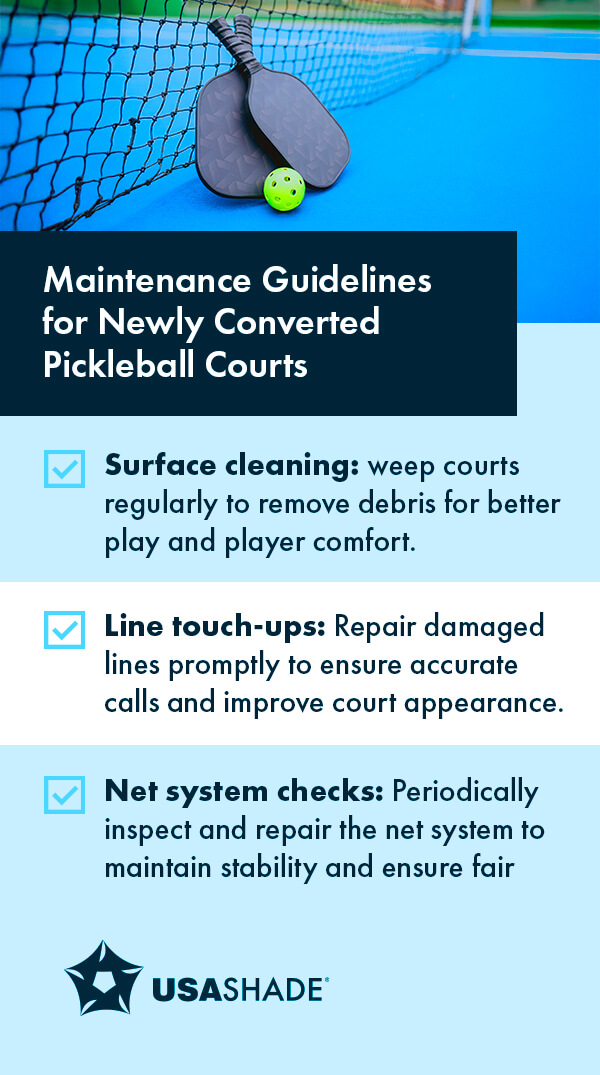
- Surface cleaning: The courts need to be swept to remove trash, leaves, dirt and other debris. Over time, these can accumulate on and around the courts and impede play. They may also just make players and spectators uncomfortable. Keeping the courts clean is an important part of supporting and maintaining an active pickleball community.
- Line touch-ups: Over time, the court lines — especially those made of chalk or tape — will likely get scraped, torn or otherwise damaged. To keep the court functional, it is important to repair or touch up these damaged lines as soon as possible. Quick line maintenance ensures that in-bounds and out-of-bounds are easier to judge and increases the aesthetic appeal of your courts.
- Net system checks: Pickleball nets and the posts and anchors that support them can become strained, torn or damaged over time. The health and stability of each of these components should be evaluated periodically to ensure that they are functioning properly. If they are not, try to conduct repairs as soon as possible. A net that has been torn or lowered or that is resting at an angle can alter player performance and the game’s overall fairness.
Frequently Asked Questions
Below are answers to some of the most frequently asked questions about converting a tennis court into a pickleball court.
How Many Pickleball Courts Fit on a Tennis Court?
Up to four pickleball courts can fit on a single tennis court. However, some court owners choose to convert the tennis court into only one or two pickleball courts for the sake of space and visual clarity. This choice is especially common if the courts are going to host community tournaments or professional play.
How Do You Play Pickleball on a Tennis Court?
The service line on a tennis court can be used to mark the non-volley zone. The general shape of the court is similar, allowing players to call shots in or out of bounds.
However, the net height and the actual dimensions of the court will be different. A tennis court is both wider and longer than a pickleball court, and the net is slightly higher. As such, a tennis court can satisfy more casual pickleball players, but it may not be enough for those who are more invested in pickleball.
How Long Does a Conversion Project Take?
The length of time will vary based on the extent of the renovations. A single court may only take a week or so to convert into a pickleball court, but if crews are installing four courts, new fences and several lighting fixtures, the process is likely to take much longer. Talk with renovation partners to assess the specific amount of time your project will take.
The Importance of Shade Structures for Your New Pickleball Court
Pickleball’s popularity has soared in recent years, and many of its most invested players have found that the best time to play the game is in the middle of summer. For many players, this is because summer is the only time of year they can play. For others, it’s because the sun gives them a chance to wear more comfortable clothing and build up a nice sweat.
However, playing outdoors in the bright sunshine can increase the risk of heat-related illnesses or simply make exercise uncomfortable, especially during hot or humid days. Pickleball court shade structures — such as canopies, shade sails and cantilevers — can make outdoor pickleball games and tournaments more comfortable for players and spectators alike. They provide UV protection, as well as glare and heat reduction. Some shade structures can even protect players and spectators from precipitation so that they can keep playing even when it is sprinkling. Plus, the translucent fabrics allow light to pass through to maintain that open-air feel.
For court owners, shade structures for pickleball courts can extend the playing hours of the courts and ensure that scheduled events can take place when weather conditions like rain arise. They may also give more players a chance to use the courts and develop a love and appreciation for the sport of pickleball, which means more active users per month.
Build Custom Pickleball Shade Structures With USA SHADE
A custom shade structure can radically transform the pickleball court, making it appeal to new players and allowing existing players to experience the game they love in absolute comfort. USA SHADE has decades of experience working with businesses just like yours to construct amazing shade structures that last for decades and increase the aesthetic appeal and performance of all kinds of facilities. We collaborate with your business every step of the way to ensure that your shade structure is more than functional — it’s stylish, too.
Check out more about our shade structures for pickleball courts. To learn more about how they can transform your facility, fill out our contact form.