

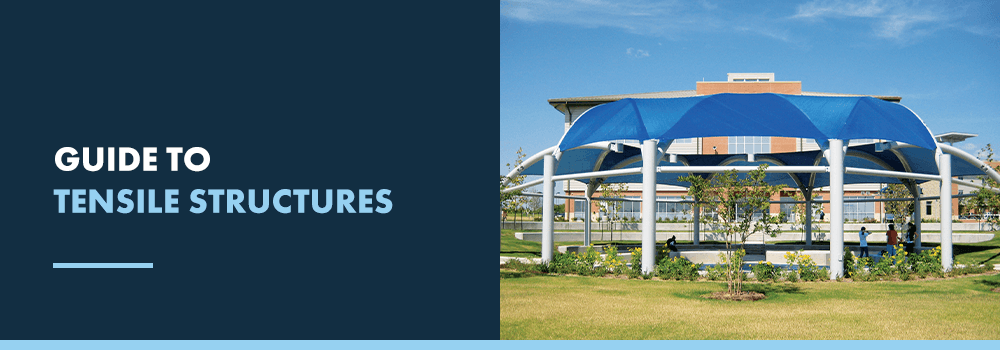
As project complexity increases and design grows more ambitious, structures must deliver visual impact and practical functionality. Tensile architecture transforms functional requirements into iconic design statements. Systems that harness the strength of fabric membranes held in tension create spaces impossible to achieve with traditional materials.
This guide is an overview of tensile structures, from core engineering principles to modern applications. Gain a clear understanding of the material options, design possibilities and key benefits, to confidently assess how tensile architecture can be applied to your business projects.
Key takeaways:
- Tensile structures use fabric membranes in tension to create column-free spaces with unique architectural forms.
- Advanced materials like PVC-coated polyester, PTFE-coated fiberglass, ETFE films and HDPE offer distinct performance characteristics.
- Benefits include design flexibility, long-span capabilities, energy savings up to 25.5% and weather resistance.
- Applications include commercial buildings, transportation facilities, sports venues, educational campuses and agricultural operations.
- Quality structures meet rigorous standards, including ASCE 55-16 and the International Building Code.
An Overview of Tensile Structures
A tensile structure is a construction in which all elements carry only tension and no compression or bending. These systems represent the most common type of thin-shell structure in modern architecture. Like a trampoline or spiderweb, fabric tensile structures rely on tension distributed across a surface to create structural integrity.
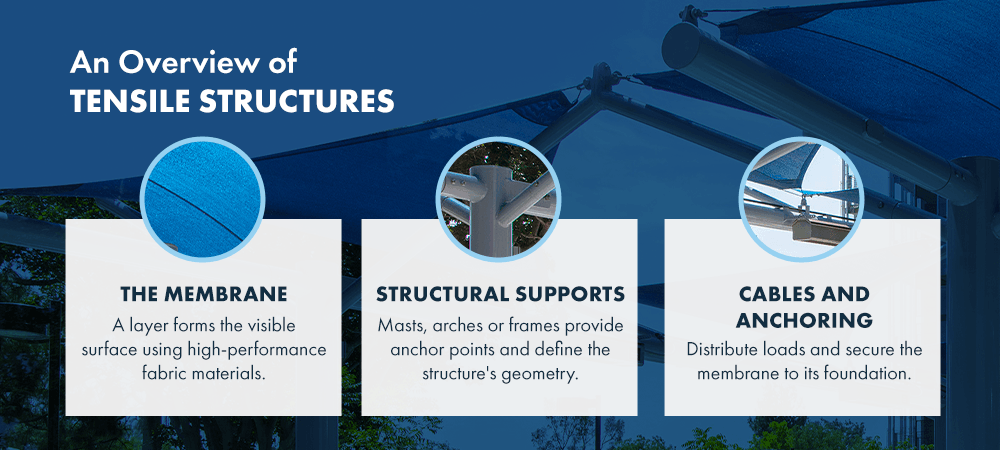
Three primary components work in harmony:
- The membrane: A layer forms the visible surface using high-performance fabric materials.
- Structural supports: Masts, arches or frames provide anchor points and define the structure’s geometry.
- Cables and anchoring: These systems distribute loads and secure the membrane to its foundation.
Tensile architecture achieves stability through carefully calculated tensioning of pre-stressed fabric membranes. This tension-based approach allows dramatic cantilevers, sweeping curves and expansive spans that conventional compression-based construction cannot achieve efficiently.
How Much Do Custom Tensile Structures Cost?
Determining the cost of a custom tensile structure requires evaluating project-specific factors:
- Project size and complexity drive material quantities and engineering requirements.
- Fabric selection impacts initial investment and long-term performance.
- Site conditions include soil composition, climate considerations and accessibility.
- Geographic location affects labor costs and permitting requirements.
Tensile construction often delivers superior value compared to conventional alternatives like steel frame buildings, concrete structures or traditional roofing systems. Tensile structures tend to use less material per square foot of coverage, which reduces raw material costs and structural dead loads. Also, installation timelines are typically shorter, minimizing labor expenses and allowing facilities to become operational sooner.
Return on investment extends beyond initial construction. Properly engineered tensile structures require minimal maintenance throughout their operational life, while energy performance advantages reduce utility expenses. Over the long term, these structures enhance property value and visual appeal.
For project-specific pricing, request a custom quote to discuss scope, materials and site conditions.
What Durability and Safety Standards Apply?
Chapter 31 of the International Building Code establishes minimum requirements for design, materials and installation of tensile membranes. For more detailed technical guidance, the American Society of Civil Engineers ASCE 55-16 provides the industry standard specifically for tensile membrane structures. This covers design methodology, load calculations, material specifications and testing protocols.
Material quality and stabilization directly affect long-term durability, particularly under UV exposure. Research on aramid fibers showed that untreated fibers retained only 25% of their strength after UV exposure, while advanced nano-stabilization enabled 93% strength retention. These findings underscore why high-quality, stabilized materials with proven UV resistance and advanced protective coatings help your facility maintain structural integrity throughout its service life.
Partnering with certified fabricators provides additional assurance:
- IAS Accreditation for steel fabrication demonstrates a commitment to quality control.
- DSA Certification for California projects ensures compliance with the state’s stringent requirements.
- Third-party verification confirms adherence to industry standards.
Can Tensile Structures Be Financed?
Commercial construction projects, including tensile structures, typically qualify for standard commercial financing options. Banks evaluate these projects using the same criteria applied to conventional construction — project scope, organizational creditworthiness and projected return on investment.
Many organizations find additional funding through grants and specialized programs. Public sector projects often qualify for infrastructure improvement grants, recreation funding or educational facility enhancement programs. Working with a knowledgeable partner who understands available grants and funding resources can help identify opportunities your business may be eligible to pursue.
The relatively shorter construction timeline of tensile structures also improves financing economics by reducing construction financing costs and enabling earlier operational capability.
Advanced Materials Used in Tensile Construction
Material selection fundamentally shapes a tensile structure’s performance, aesthetic character and operational costs. Tensile architecture relies on engineered fabrics that combine base textiles with protective coatings or films. The synergy between substrate and coating determines the membrane’s ultimate performance.
PVC-Coated Polyester
Polyvinyl chloride-coated (PVC) polyester is the most widely specified material in tensile construction because it balances performance, versatility and cost-effectiveness. PVC coating transforms fabrics into high-performance materials with exceptional resistance to dirt, chemicals, UV light and general abrasion.
Research suggests that tear strength decreases as temperatures rise, making material composition critical for hot climates. Fabrics engineered with thicker yarns achieve 53% higher tear strength through optimized yarn specifications.
PVC-coated polyester performs well for:
- Commercial shade structures where aesthetics meet functionality.
- Covered walkways and plaza canopies requiring environmental protection.
- Parking facilities needing durable, cost-effective coverage.
- Installations with moderate life span requirements.
The material’s availability in numerous colors and translucency levels allows designers to tailor light transmission and visual impact.
PTFE-Coated Fiberglass
For high-quality outdoor tensile structures, polytetrafluoroethylene (PTFE) coated fabrics offer exceptional performance. These materials demonstrate remarkable temperature stability, remaining unchanged across a broad range from minus 20° Celsius to 70° Celsius. This makes them highly reliable in diverse climates.
Their mechanical properties are predictable, allowing engineers to accurately design for specific tensile strengths and strain rates using advanced criteria. This deep understanding of PTFE’s behavior ensures robust, durable and precisely engineered solutions for demanding architectural and outdoor applications.
ETFE Films
Ethylene tetrafluoroethylene (ETFE) is a lightweight, transparent alternative to glass, frequently used in cushion form for roofs and facades. Its application in iconic tensile structures like the Eden Project in the UK and the National Swimming Center in China showcases its versatility.
Historically, accurately predicting ETFE’s strength for design has been challenging due to empirical methods. However, advanced engineering methodologies introduce new ways to define essential design strength and a unified strength condition for ETFE membrane materials. This means engineers can now achieve more accurate designs and stronger performance predictions, leading to even more reliable, innovative and higher-quality ETFE tensile structures.
ETFE cushion systems typically consist of two or three layers of film inflated with low-pressure air. The result is insulating cavities that improve thermal performance while maintaining transparency. The material excels in applications requiring:
- Maximum natural light penetration combined with minimal structural weight
- Dramatic roof systems over pools, botanical facilities or public spaces
- Facade systems that create visual lightness and transparency
- Structures where thermal insulation and light transmission must perform at high levels
HDPE Thermoplastic
High-density polyethylene (HDPE) is a durable polyolefin thermoplastic, particularly popular for shade structures. HDPE offers impressive strength-to-weight ratios and excellent UV resistance, maintaining structural and aesthetic properties for years of direct sun exposure.
Manufacturers offer a wide variety of fabric colors with colorant integrated throughout the material rather than applied as a surface treatment. This ensures a consistent appearance even as the fabric ages.
HDPE’s open-weave construction allows air circulation while blocking solar radiation to create comfortable outdoor spaces. This breathability makes HDPE excellent for hot climates where air movement enhances comfort.
Common applications include:
- Educational facility playgrounds requiring protective shade
- Park and recreation areas where ventilation matters
- Automotive shade structures balancing sun protection with airflow
- Commercial outdoor dining areas that rely on comfortable microclimates
For facilities evaluating material options, guides to the best fabric for shade structures can help clarify the decision-making process.
4 Benefits of Building With Tensile Structures
Beyond their striking visual impact, tensile fabric structures deliver practical advantages that directly translate into project performance and operational value.
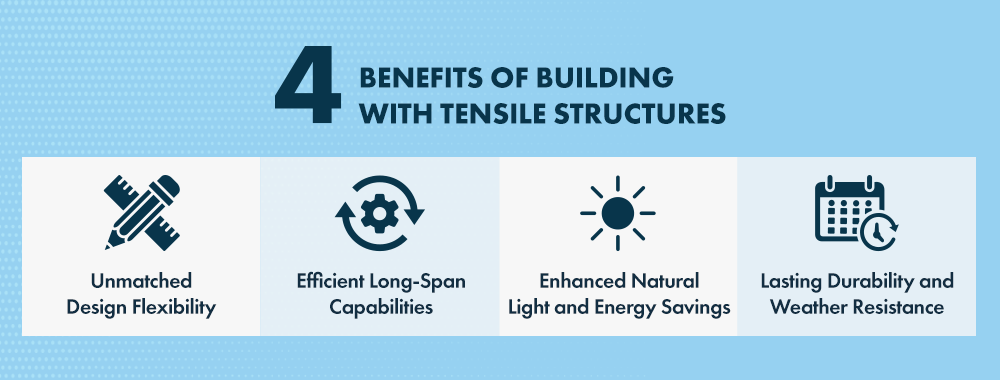
1. Unmatched Design Flexibility
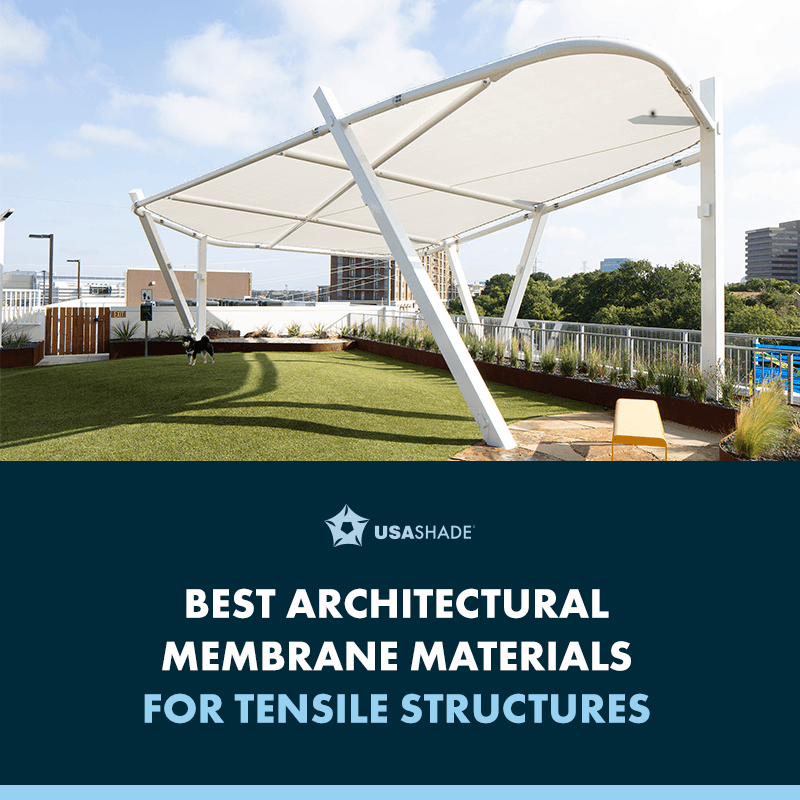
The nature of fabric enables forms impossible with rigid materials. Tensile fabric structure design frees your project to create custom structures that become landmarks within their environments, transcending rectangular constraints of conventional construction.
This design freedom serves aesthetic and functional purposes:
- Complex, double-curved surfaces direct rainwater to designated collection points and prevent standing water.
- Sculptural forms can reinforce brand identity, enhance wayfinding or celebrate cultural significance.
- Fabric selection, color specification and translucency allow designers to choreograph light and create distinctive interior atmospheres.
For organizations seeking differentiation through design, tensile fabric architecture offers virtually unlimited creative potential while maintaining structural integrity.
2. Efficient Long-Span Capabilities
Tensile structures excel at covering vast areas with minimal intermediate supports, resulting in open, column-free spaces that maximize usable area. This efficiency stems from how tensioned fabric distributes loads across its entire surface rather than concentrating forces at specific points.
The practical advantages include:
- Athletic facilities gain unobstructed playing surfaces
- Clear circulation paths in automotive structures accommodate vehicles and pedestrians
- Public gathering spaces maintain visual clarity and openness
- Fewer foundations to engineer and construct, reducing below-grade costs
3. Enhanced Natural Light and Energy Savings
Translucent membranes transform sunlight into soft, diffused illumination that reduces or eliminates artificial lighting during daylight hours. Research on prototype buildings with tensile membrane roofs demonstrated energy savings up to 25.5% compared to conventional control strategies. These energy reductions translate into operational cost savings that accumulate over the structure’s life span.
Material selection provides options for precise control over light transmission — translucent fabrics can admit diffused daylight while controlling solar heat gain, while opaque materials offer complete shelter where direct sun control is paramount.
4. Lasting Durability and Weather Resistance
Properly engineered tensile structures deliver decades of reliable performance with minimal maintenance requirements. Membrane materials can resist UV degradation, moisture penetration, biological growth and environmental pollutants.
Key durability features:
- High-quality fabrics: Materials can incorporate UV stabilizers, antimicrobial treatments and protective coatings that maintain structural properties throughout extended service lives.
- Active weather shedding: Pretensioned fabric actively sheds water and debris, preventing accumulation.
- Minimal maintenance: Regular inspection and occasional cleaning are the primary requirements. Far less demanding than conventional roofing systems.
Engineered waterproof tensile structures provide shelter for facilities requiring protection from rain and the elements. The fabric’s flexibility allows structures to accommodate wind loads, thermal expansion and minor structural movement while maintaining structural integrity.
Tensile Fabric Structure Designs and Applications
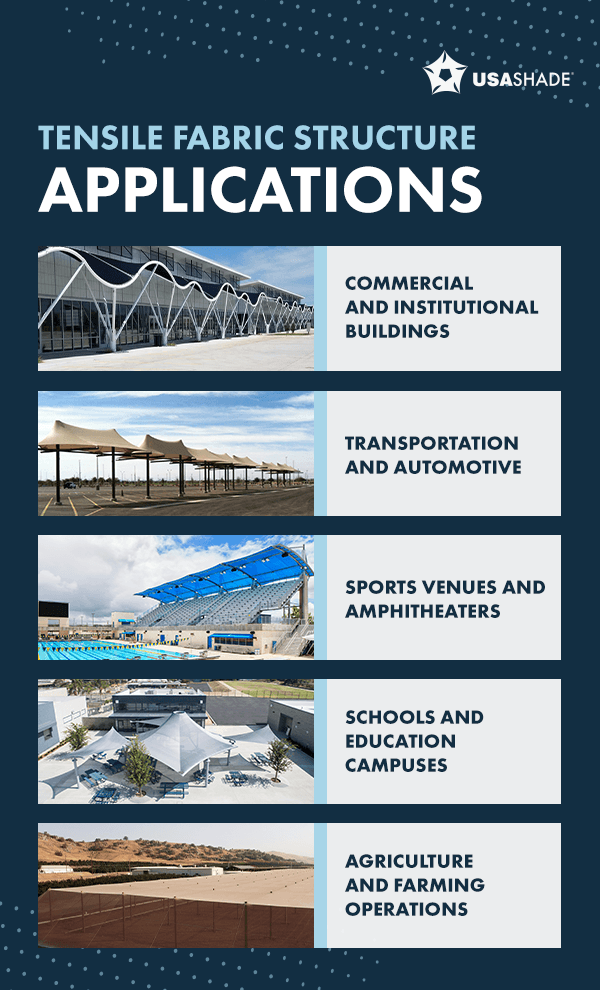
Tensile architecture serves many industries and applications by leveraging the technology to solve spatial and functional challenges.
Commercial and Institutional Buildings
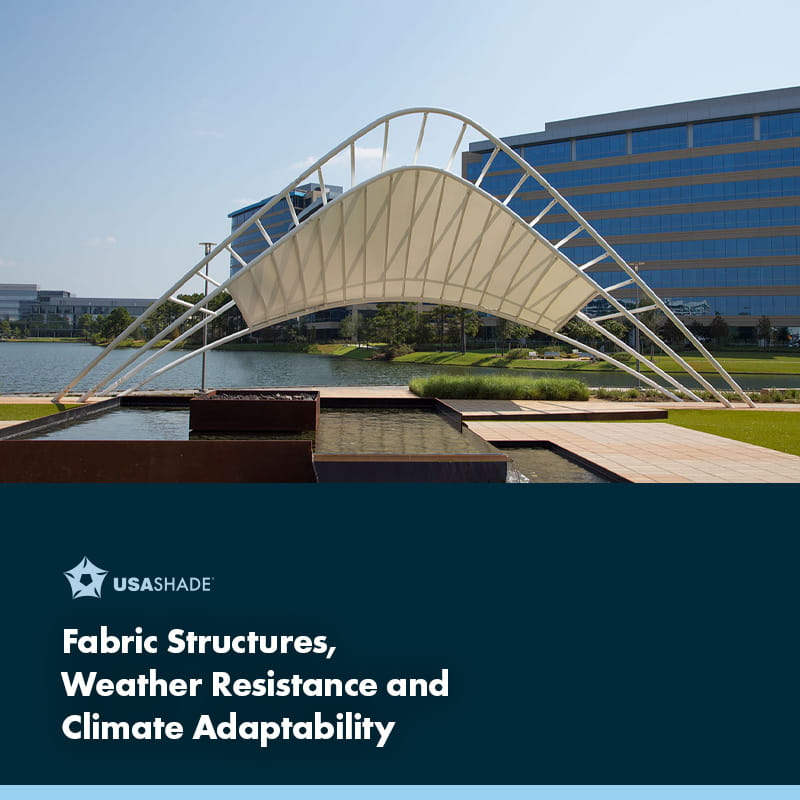
Tensile canopies create design statements for corporate and commercial projects seeking to establish site presence and brand identity. Institutional buildings and government facilities use tensile construction’s ability to balance monumentality with approachability. These principles apply to public plazas and outdoor gathering spaces that benefit from tensile canopies, providing shelter while preserving the open character that encourages year-round use.
Transportation and Automotive
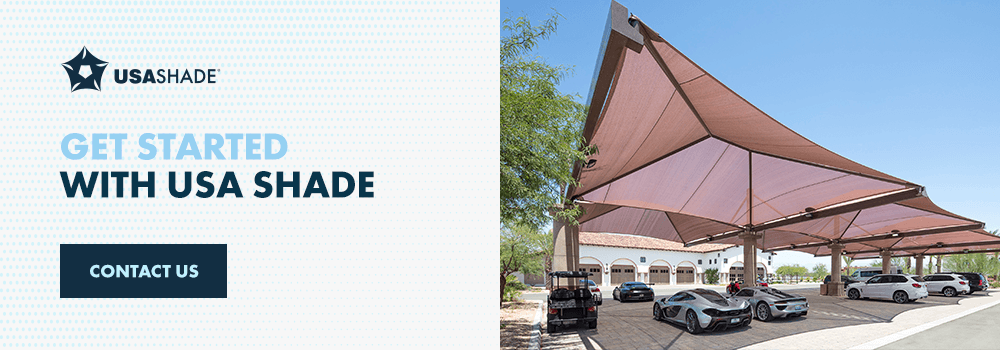
Automotive facilities are one of tensile construction’s most popular applications. Cantilever designs are ideal for covered parking solutions that provide shade and environmental protection while maintaining clear, open circulation.
Transportation applications extend beyond parking:
- Airports and transportation facilities use tensile structures for terminal canopies and curbside pick-up areas.
- Bus terminals and rail platforms protect waiting passengers while maintaining a visual connection to approaching vehicles.
- High-traffic areas benefit from large clear spans, durability and design excellence.
Sports Venues and Amphitheaters
The long-span capabilities of tensile architecture make it exceptionally well-suited for athletic stadiums and sports facilities. Grandstand canopies provide sun and environmental protection for spectators while preserving clear sightlines to the field. Recreation complexes use tensile structures over tennis courts, swimming pools and multisport surfaces to extend the usable season.
Performance spaces present another application for tensile construction. Amphitheater and venue projects benefit from the technology’s combination of acoustic properties and visual impact. When properly designed, membrane structures can enhance sound distribution and create intimate acoustic environments.
Schools and Education Campuses
Educational facilities use fabric tensile structures to expand usable space economically. Solutions for schools and universities typically address these needs:
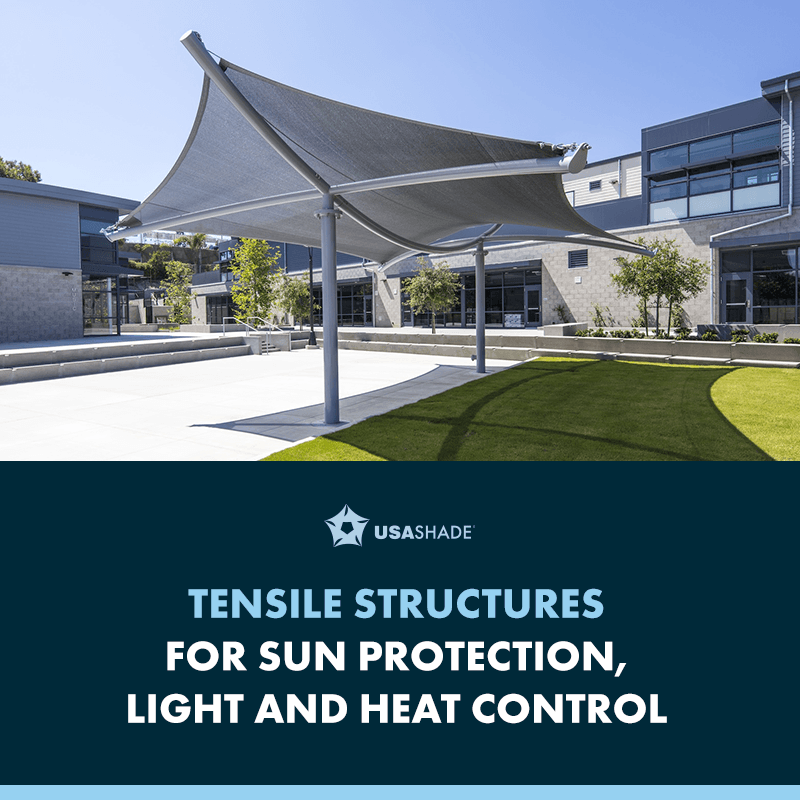
- Playground shade structures protect children from excessive sun exposure and reduce surface temperatures on play equipment.
- Tensile canopies transform outdoor areas into functional classrooms that maintain connection to nature while expanding teaching space.
- Covered walkways connecting campus buildings improve accessibility during inclement weather and create cohesive campus experiences.
Agriculture and Farming Operations
Tensile applications in agriculture and farming provide equipment storage that protects valuable machinery from environmental exposure, at a cost less than the foundation work and expense required by conventional buildings.
These same cost advantages extend to crop protection, where tensile structures create controlled microclimates that extend growing seasons and shield sensitive plants. For livestock operations, facilities use tensile canopies to provide shade in feedlots and shelter in pastures, improving animal comfort while reducing infrastructure costs.
The Design and Installation Process
Understanding the end-to-end process helps organizations plan and set appropriate expectations. The workflow typically includes:
- Initial consultation: This first step establishes project parameters, including site conditions, functional requirements, aesthetic preferences, budget and timeline.
- Design development: The second phase translates concepts into buildable solutions through iterative processes. The aim is to balance aesthetic intent with structural requirements.
- Engineering and permitting: Designs are transformed into construction documents with structural calculations verifying load resistance.
- Fabrication: Membrane panels are cut precisely to engineered patterns with quality control ensuring materials meet specifications.
- Installation: Specialized teams tension membranes properly and integrate all system components.
- Final inspection: Completed structures are confirmed to meet design intent and satisfy code requirements.
Service providers offering full in-house capabilities streamline this process by eliminating coordination challenges. An Architectural Specialist Division can provide valuable support, particularly for projects involving architects and engineers specifying tensile structures for the first time.
Get Started With USA SHADE
For over 25 years, USA SHADE has pioneered fabric tensile design and technology to deliver solutions across North America.
Your business benefits from our complete in-house capabilities across design development, structural engineering, manufacturing, project management and construction. This integrated approach delivers seamless coordination, consistent quality and projects that meet the highest industry standards. We are your partner in transforming ambitious visions into remarkable built environments that leverage tensile architecture.
Request a quote to discuss your facility’s specific requirements with our design experts, or contact us today to discover the unlimited possibilities of tensile construction.