

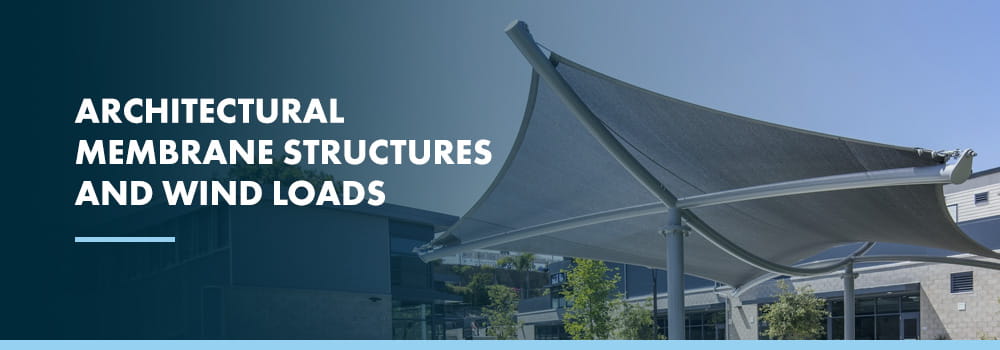
Architectural membrane structures offer unparalleled aesthetic possibilities — sweeping curves, translucent canopies and gravity-defying forms.
However, these striking designs must withstand the forces of nature. Wind loads present one of the most critical engineering challenges for fabric structures. Unlike rigid buildings, membranes rely on tension, flexibility and carefully calibrated geometry to resist wind loads. Designing for wind requires understanding material behavior, site-specific conditions and structural analysis methods that go beyond conventional codes.
Engineering principles, materials and design validations enable membrane structures to handle significant wind loads while delivering the architectural vision your business demands.
What Is an Architectural Membrane?
An architectural membrane consists of tensioned fabric that works in conjunction with cables, columns and other construction elements to create functional, expressive forms. These systems utilize high-performance materials such as high-density polyethylene (HDPE), polyvinyl chloride (PVC) and polytetrafluoroethylene (PTFE) to achieve both structural integrity and visual impact, offering unique architectural forms that designers cannot replicate through conventional construction methods. They provide versatility and sustainability, enabling large spans, natural light and unique shapes, often with a smaller carbon footprint thanks to their lightweight design.
Why Wind Loads Are Critical for Membrane Structures
The lightweight, flexible characteristics that make membrane structures architecturally compelling also create unique vulnerabilities under wind exposure. Unlike rigid buildings that resist atmospheric pressure through sheer weight and stiffness, membranes must manage dynamic loads.
Wind pressure on a structure manifests in three primary categories:
- Uplift (vertical lifting forces)
- Shear (twisting and racking forces parallel to walls)
- Lateral loads (horizontal pushing forces)
These pressures can lead to fabric flapping, stress concentrations, connection failure or structural collapse. For architects and engineers specifying membrane installations, understanding these load paths and failure modes is fundamental to delivering projects that perform reliably over their intended life span.
How Do Architectural Membranes Handle Wind Loads?
Wind design for fabric structures follows many of the same fundamental principles as conventional construction, but the unique properties of membranes require specialized analytical approaches.
American Society of Civil Engineers (ASCE) 7: Minimum Design Loads and Associated Criteria for Buildings and Other Structures provides general provisions applicable to most building types, but often lacks the specific parameters needed to address flexible membrane systems. For this reason, ASCE 7 wind load standards serve as a foundation but require supplementation for membrane applications.
Key Considerations for Determining Wind Loads for Membrane Structures
Accurate load determination depends on understanding site-specific and structural variables that influence pressure and distributions across the fabric surface.
Wind Speed
ASCE establishes regional design velocities based on statistical analysis of historical weather data. Velocities vary by geographic region, reflecting local climate patterns. The applicable speed serves as the starting point for all load calculations and directly influences material choices.
Surrounding Environment
The immediate site context plays a critical role in determining actual atmospheric pressure. Surrounding buildings in urban or suburban environments can alter flow patterns, creating channeling effects, downwash or unexpected turbulence that amplifies pressures beyond what open-terrain calculations predict. Geographical features such as water bodies, open fields and mountains can similarly intensify exposure.
Design codes address these variables through “exposure categories” that adjust base velocities according to terrain roughness:
- Exposure B: This category applies to urban and suburban areas, wooded areas or other terrain with many closely spaced obstructions that reduce velocities at ground level.
- Exposure C: Open terrain with scattered obstructions falls into this category. Obstructions have heights less than 30 feet.
- Exposure D: Flat, open shorelines exposed to air flowing over open water produce the most severe conditions and receive this classification.
Proper determination of the exposure category per ASCE 7 is essential for accurate load analysis. For complex environments, consider site-specific studies or computational fluid dynamics modeling.
Building Height and Shape
Structural height significantly influences load calculations. The height criteria in ASCE 7 change substantially at 60 feet above ground elevation, including stem walls. Installations exceeding this threshold experience higher atmospheric pressure due to reduced sheltering and exposure to higher-velocity flows.
Geometric form is equally important. ASCE provisions provide pressure coefficients for common building shapes, but fabric installations often feature uncommon geometries such as complex multi-peak configurations.
When a structure’s shape falls outside standard coefficient tables, tunnel testing becomes necessary to establish accurate pressure distributions. These physical model studies capture the actual aerodynamic behavior of the specific form.
High-Performance Architectural Fabrics for Wind Resistance
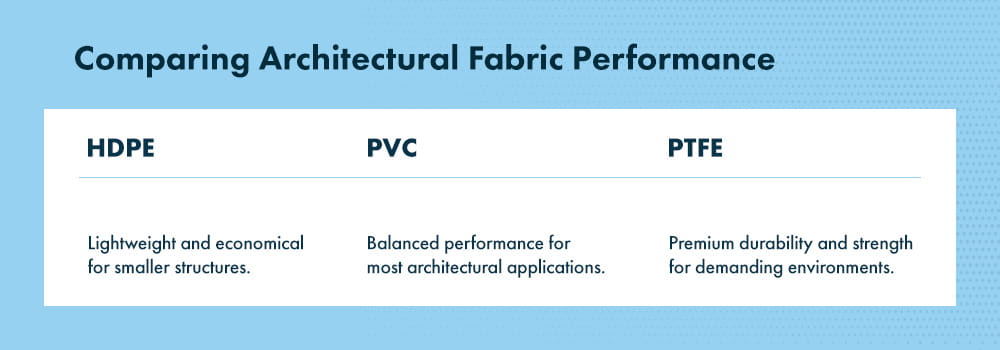
Fabric choice directly determines a membrane’s ability to withstand atmospheric forces over its design life. Engineers and designers rely on HDPE, PVC and PTFE fabrics to efficiently carry wind loads.
Each fabric type offers distinct mechanical properties that influence structural performance:
- HDPE: Manufacturers weave and coat high-density polyethylene fabrics to provide a lightweight, cost-effective solution with good UV resistance. However, HDPE delivers lower tension strength and tear resistance, limiting its application to smaller spans or lower exposure conditions.
- PVC: Polyvinyl chloride-coated polyester fabrics balance tension strength, tear resistance and flexibility. Engineers can specify formulations with UV inhibitors and flame retardants, making this material suitable for a wide range of applications.
- PTFE: Polytetrafluoroethylene-coated fiberglass fabrics represent the premium option, offering exceptional tension strength, superior durability and outstanding UV resistance. The low coefficient of friction aids in self-cleaning and reduces snow accumulation.
Design Factors for Wind Resistance
Beyond material choice, several advanced engineering considerations govern how effectively a membrane installation resists atmospheric forces.
Geometric Nonlinearity
Architectural membranes are inherently flexible installations that experience large deformations under load. Fabric assemblies can undergo shape changes that significantly alter how forces distribute through the system. This necessitates geometric nonlinear analysis, where engineers formulate equilibrium equations based on the deformed geometry rather than the initial configuration.
The analytical complexity of fabric design distinguishes it from conventional structural engineering and requires specialized software and expertise.
Membrane Prestress
Prestress refers to the initial, carefully controlled tension applied to the fabric during installation. The supporting structure maintains this stress through cables, masts or edge beams, making it fundamental to structural performance. The role of membrane stress is to:
- Activate tension capacity: The material’s inherent strength engages immediately, allowing the fabric to resist applied loads without going slack.
- Maintain form: By locking the fabric into its designed double-curved shape, initial tension prevents uncontrolled deformations.
- Reduce deformation: Adequate prestress limits excessive movement under live loads, preventing wrinkling, sagging and aerodynamic instability.
Rise-Span Ratio
The rise-span ratio expresses the proportion of vertical height (rise) relative to horizontal extent (span) and fundamentally influences structural stiffness and aerodynamic behavior. Higher ratios provide:
- Increased curvature: A steeper profile delivers inherent geometric stability, similar to how a deep arch outperforms a shallow arch under load.
- Efficient load transfer: Rather than relying on material thickness, increased geometry enables more direct transfer of forces through in-plane tension stresses, reducing stress concentrations.
Installations with insufficient ratios may experience excessive deflections, ponding or inadequate performance despite proper prestress and material choice.
Dynamic Response
Dynamic response characterizes how a structure reacts to time-varying loads such as turbulent gusts. Accounting for dynamic behavior minimizes the risk of oscillations that could lead to fatigue, tearing or progressive failure. For critical applications or unusual geometries, tunnel testing with aeroelastic models provides the most reliable assessment.
Partner With USA SHADE on Your Next Project
Designing architectural membranes for wind load is a complex engineering challenge that demands both technical expertise and collaborative problem-solving. USA SHADE brings over 25 years of experience delivering fabric structures that meet rigorous load requirements without compromising aesthetic vision.
With in-house engineering, design, fabrication and construction capabilities, USA SHADE serves as a single-source partner for architects and design professionals. You can learn more about our Architectural Studio and how we collaborate with teams to create custom wind-resistant structures on our site.
Contact us today to find out more about how we can incorporate durable shade structures into your next project.