For decades, mentions of wet-bulb globe temperature remained mostly confined to the pages of military manuals and sports medicine journals. That changed for Texas schools on Aug. 1, 2026, when the University Interscholastic League made real-time WBGT monitoring mandatory for outdoor athletic activities and marching band practice statewide.
While most people are already familiar with the heat index, WBGT is a different, more demanding calculation. Knowing what WBGT measures, how it compares with the heat index, what the recently released mandate requires and how shade can influence those readings will help your facility confidently meet the new standard.
WBGT Explained
In the 1950s, heat illness became a serious problem for Marine Corps trainees at Parris Island, S.C., inspiring the U.S. military to develop a new measurement that shows how well a human body can cool itself through sweat evaporation while doing outdoor activities in direct sunlight.
Instead of relying solely on humidity and temperature, WBGT combines five environmental variables into a single reading, giving your school’s program a fuller picture of real-world heat stress.
- Air temperature: Reflects standard ambient heat in shaded areas.
- Humidity: Determines how effectively sweat evaporates and cools the skin.
- Wind speed: Affects how quickly evaporative cooling occurs.
- Sun angle: Influences the intensity of direct solar exposure.
- Cloud cover and solar radiation: Determine how much radiant heat reaches the ground and athletes below.
Three separate thermometers generate the inputs behind this calculation.
- Wet bulb: Enveloped in a damp cloth, this thermometer mirrors how the body sweats and captures humidity’s and wind’s effects.
- Black globe: Housed inside a 6-inch black copper globe, this thermometer absorbs the sun’s radiant heat.
- Dry bulb: Measures the standard ambient air temperature with shade.
Here is the formula to calculate WBGT — 0.7 x wet-bulb temperature + 0.2 x black-globe temperature + 0.1 x dry-bulb temperature.
WBGT vs. Heat Index
The primary difference between WBGT and heat index is scope. While the heat index measures temperature and humidity, wet-bulb globe temperature also measures total heat stress by factoring in sun angle, wind speed and cloud cover.
WBGT readings are often lower than the heat index because reduced solar radiation offsets the added humidity factor. However, games and practices held on bright, sun-exposed Texas afternoons can elevate WBGT readings.
That distinction is critical. The heat index assumes shade is available and can underestimate the effects of heat stress on a sun-exposed field, while WBGT reflects the real-world conditions student-athletes train in. OSHA, the American College of Sports Medicine, the military and now the UIL all rely on WBGT rather than the heat index for this reason.
| WBGT | Heat Index | |
|---|---|---|
| Measured in | Direct sunlight | Shade |
| Variables used | Temperature, humidity, wind, sun angle, solar radiation | Humidity and temperature only |
| Accounts for radiant heat | Yes | No |
| Used by | Military, OSHA, ACSM, UIL | General public weather forecasting |
| Best for | Outdoor athletes, outdoor workers | Day-to-day weather planning |
What Texas Schools Need to Know About the UIL’s New WBGT Mandate
Effective Aug. 1, 2026, the new UIL heat guidelines require every member school to monitor WBGT for outdoor athletic and marching band activities — a shift from recommended use to a mandatory statewide standard.
These thresholds mirror ACSM guidelines already used at the college level, reinforcing that this framework reflects established science rather than new or experimental policy.
Here’s what compliance looks like in practice.
- Activities covered: Outdoor athletics and marching band practices alike fall under the mandate.
- Reading frequency: Staff must take a WBGT reading within 15 minutes of practice beginning and every 30 minutes thereafter.
- Approved tools: Your program can use an on-site WBGT monitor or an approved internet-based weather application to pull readings.
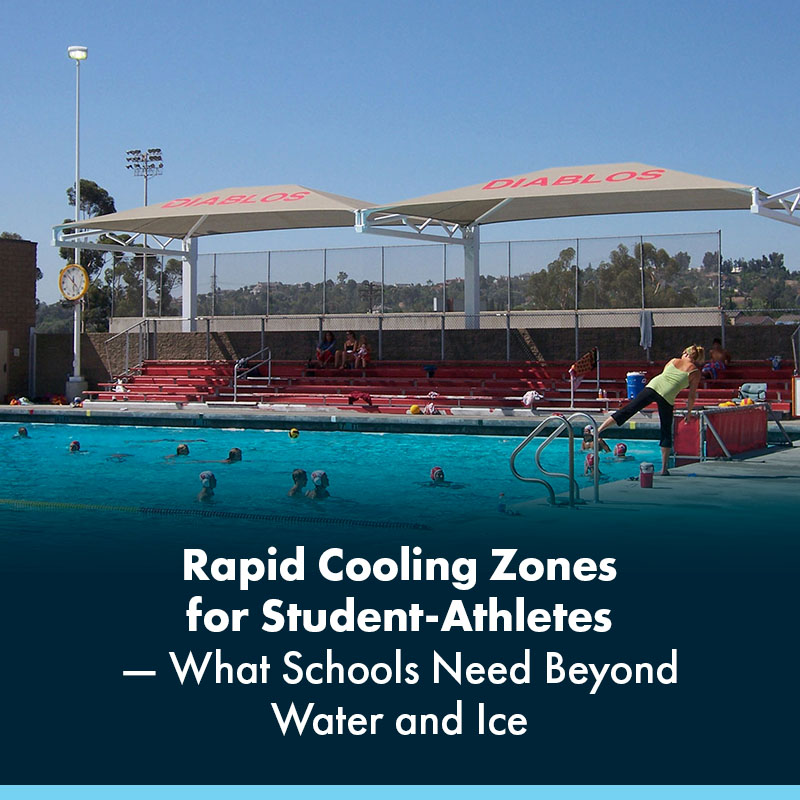
- Rapid cooling zones: Class 2 schools should have a rapid cooling zone available once WBGT reaches 79.7° Fahrenheit, and Class 3 schools once it reaches 82.0° Fahrenheit, with full-body immersion capability, such as ice baths, on hand.
Shade Structures Do More Than Make Athletes Comfortable
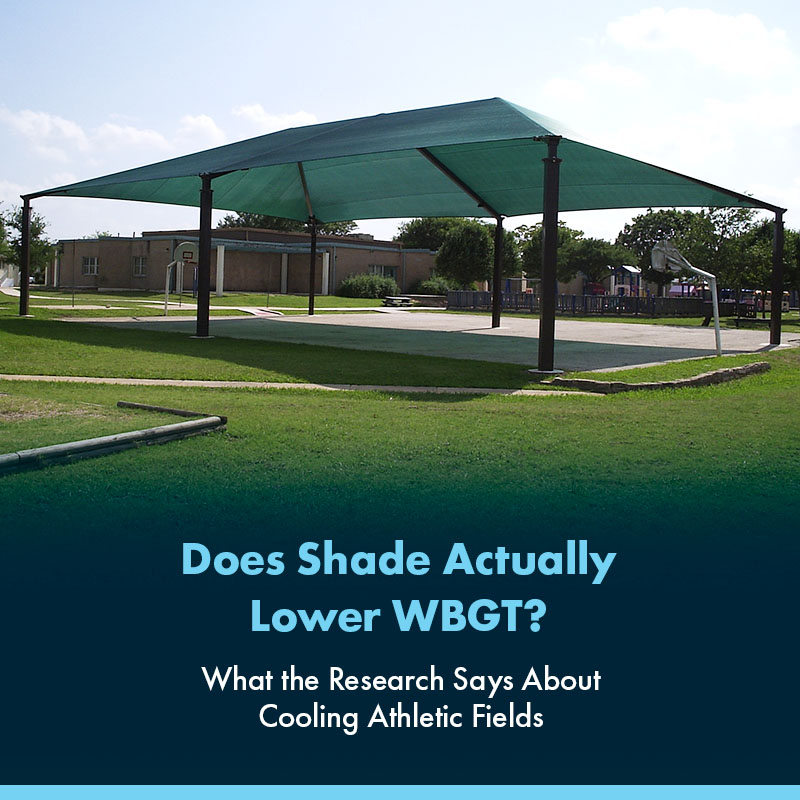
Because shade structures block direct sunlight and radiant heat, they can measurably reduce this component of the reading on your school’s fields and courts — not just make athletes feel more comfortable underneath them.
Shade affects the WBGT formula in a few specific ways.
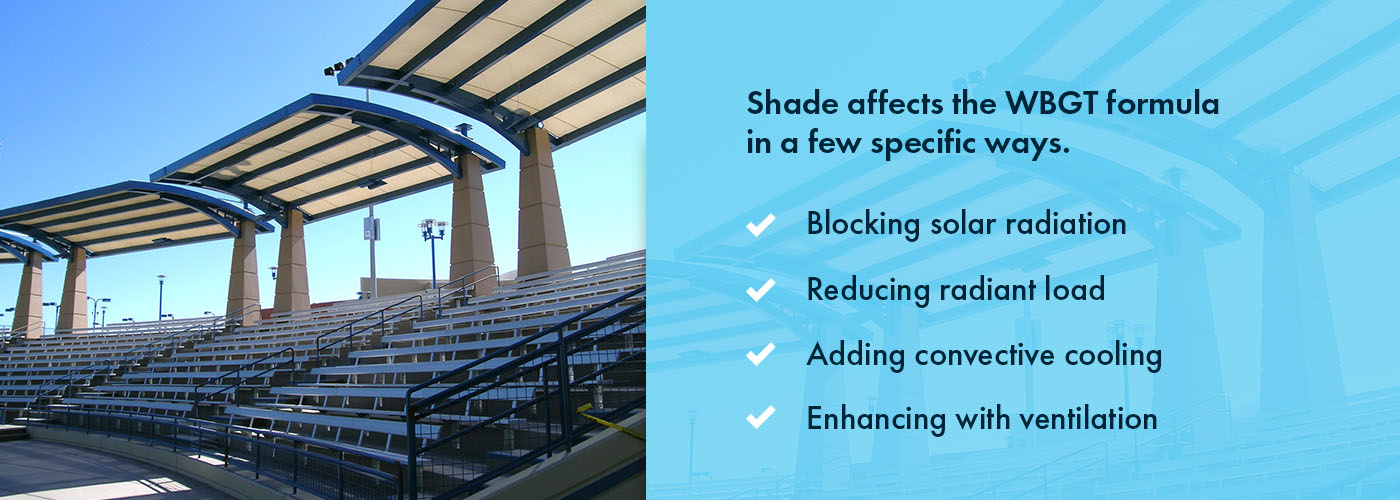
- Blocking solar radiation: Roofs and high-density fabric prevent direct sunlight from reaching the ground or players below.
- Reducing radiant load: Lower direct exposure drops the mean radiant temperature in the immediate environment.
- Adding convective cooling: Porous shade cloth and open-air pavilions allow air to move, preventing heat from becoming trapped beneath the structure.
- Enhancing with ventilation: According to a 2026 shade pavilion study of 221 U.S. locations, mechanical ventilation under a shade structure can add an extra 1.4° Celsius, or about 2.5° Fahrenheit, of cooling during peak summer heat. Researchers found shading alone reduced midday WBGT by an average of 2.4° Celsius, or roughly 4.3° Fahrenheit, with the largest reductions in the southeastern and western U.S. — the regions with the heaviest solar radiation loads.
How Shade Structures Can Lower WBGT Readings on Fields and Courts
Even a modest reduction can shift a reading into a lower activity-modification zone, allowing practices to continue with fewer restrictions. In hot regions, that kind of shift can translate into over 60 additional normal-activity days each summer.
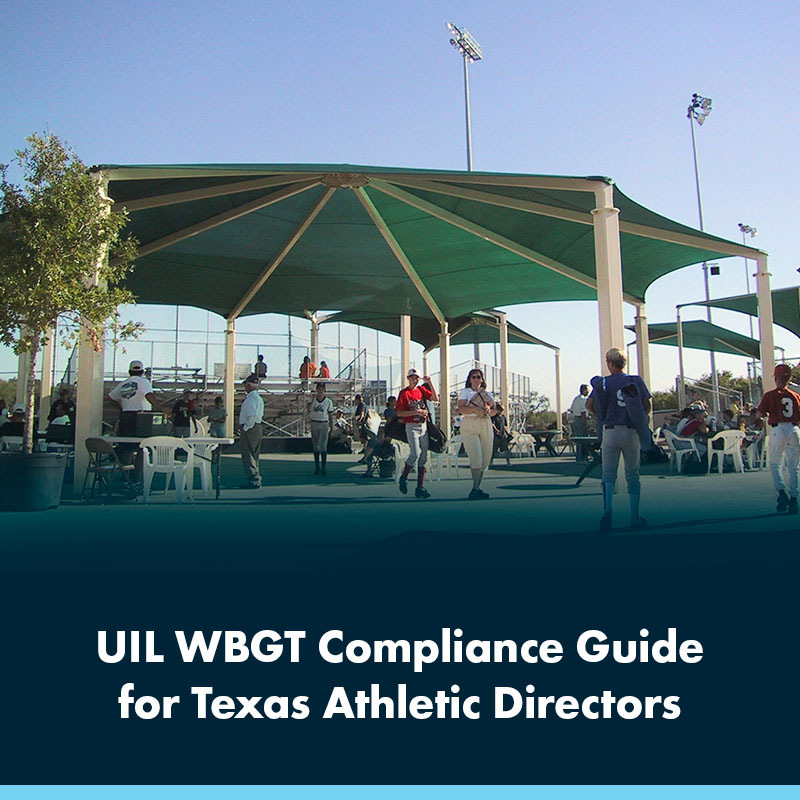
Placement matters as much as the structure itself. Sidelines, dugouts, tennis courts, outdoor basketball courts, bleacher areas and track and field zones all put athletes and supervisors in direct sun for extended stretches, making them practical candidates for coverage.
High-density polyethylene fabrics provide up to 97% UV protection, offering durable, porous overhead coverage that cuts radiant heat and can lower temperatures beneath a structure by up to 20° Fahrenheit. An experienced engineering and design team can recommend the correct shade structures for your athletic facility, including those for training facilities. For a real-world example, see one Central Texas school’s shaded court.
Talk to USA SHADE About Shade Solutions for Your School or Athletic Program

Once you have a working knowledge of WBGT, you can begin implementing real-time WBGT monitoring at your facility. Since 1991, USA SHADE has helped schools, parks and athletic programs create permanent shade structures built from steel and fabric. Our engineering and design team will work with your school or program from the initial concept through installation, tailoring solutions to specific fields, courts and gathering spaces.
If your program is ready to explore how shade could support cooler practice conditions, speak to an expert today. Let us help your school turn the new compliance requirement into a comprehensive, long-lasting facilities plan.