Every year, roughly 9,000 high school athletes across the United States are treated for heat-related illness. That reality shapes every practice schedule athletic directors and facilities managers build once temperatures climb.
Wet-Bulb Globe Temperature, or WBGT, is the metric that governing bodies such as the American College of Sports Medicine and the National Athletic Trainers’ Association use to measure the effects of temperature and solar radiation on the body. These measurements impact rest breaks, activity modifications and cancellations for athletic teams.
Shade structures are often proposed as part of the solution, but proposals alone don’t satisfy a compliance officer. This guide will outline how to lower WBGT using shade, drawing on a 2026 peer-reviewed study that finally puts independent numbers behind the claim.
How Shade Structures Lower WBGT
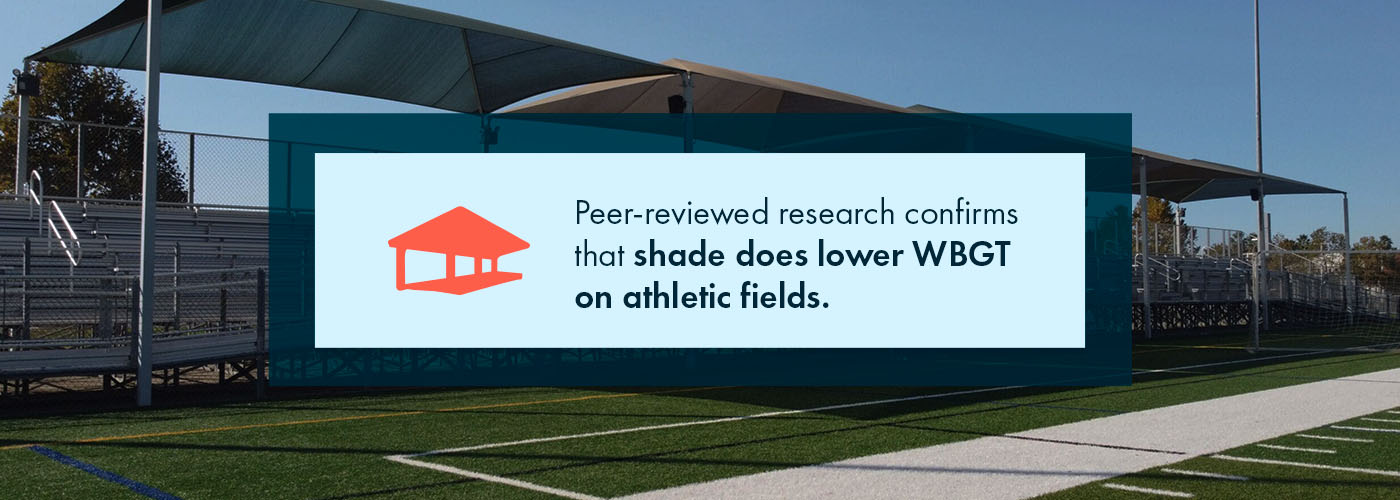
Peer-reviewed research confirms that shade does lower WBGT on athletic fields. Specifically, shade structures reduce the heat index in outdoor athletics by blocking direct solar radiation, thereby lowering the radiant heat load on a student-athlete’s body.
A 2026 study by Grundstein et al., published in Theoretical and Applied Climatology, built its conclusions on 15 years of climate data. This data was collected across 221 U.S. weather stations, drawing on more than 30,000 hourly observations per station.
That dataset scale lends the findings statistical weight, and it’s part of why the study has drawn attention from facilities managers well beyond the climate science community. The research isolated these three core findings:
- Shade alone delivers meaningful cooling: Blocking direct sunlight reduces midday WBGT by an average of 2.4°C, with a range of 1.8°C to 3.2°C across all 221 stations studied.
- Mechanical ventilation adds further reduction: Pairing shade with mechanical ventilation yields an additional 1.4°C reduction on average, since moving air carries heat away from the body more efficiently than shade alone.
- Combined systems produce the largest gains: Shade paired with mechanical ventilation reduces temperatures by an average of 3.8°C, with top-performing stations reaching 2.6°C to 5.3°C.
This data isn’t an isolated finding. A separate 2023 study by Hall and Horta found that reducing incident solar radiation by 90% decreased WBGT by 2 to 6° Celsius, depending on location.
That same mechanism explains how shade structures block radiant heat before it ever reaches the playing surface, rather than simply cooling the air after the fact.
Translating a 2.4°C Drop Into Practice Days and Compliance Decisions
A 2.4°C average reduction might sound modest on paper, but it isn’t just a comfort improvement. It often marks the difference between one ACSM activity modification category and the next, which changes what your business’s coaching staff can actually schedule that afternoon.
The Grundstein study documents the American College of Sports Medicine’s activity modification scale directly, giving facilities managers a shared reference point with athletic trainers and compliance officers:
- 22.2°C or below: Normal activity is permitted.
- 22.3°C to 25.6°C: Normal activity continues, with rest breaks and fluid intake adjustments. Limited protective equipment.
- 25.7°C to 27.8°C: Normal activity continues, but in addition to rest breaks and adjusted fluid intake, consider removing protective equipment. Breaks are also required — at least three per hour, each lasting at least four minutes.
- 27.9°C to 30.0°C: Rest-to-work ratios increase, with a minimum of four four-minute breaks required. Protective equipment is not advised, and at-risk individuals should exercise caution.
- 30.1°C to 32.2°C: Limit exercise to one hour or less, and suspend conditioning activities. No protective equipment should be in use, and at least 20 minutes of rest is advised. Remain vigilant for any signs of changes in health.
- 32.3°C or above: Outdoor exercise is a risk and should be canceled.
That threshold-crossing effect shows up clearly in the study’s operational outcomes, which translate the temperature data into the scheduling language athletic directors use every day:
- Fewer modified practices: Required activity modifications drop from roughly 35% to about 14% of early-afternoon hours under shaded conditions.
- Far fewer cancellations: Practice cancellation frequency falls from around 5% to less than 1%, a difference that can preserve an entire week of preseason conditioning.
- More usable days per season: In Phoenix and Miami, shade adds 67-68 additional summer days when full normal activity is permitted at noon.
Effective shade reduces solar heat exposure and WBGT, which is where coaches see fewer canceled practices, protective gear restrictions and heat-related illnesses. Large reductions are seen in the western and southeast United States — the same hot-climate markets where athletic facility shade structures can support more consistent summer scheduling as heat pressure grows.
Why a Shade Structure’s Design Determines Real-World WBGT Results
The Grundstein data models ideal conditions — the best-case WBGT reduction a well-placed shade structure can achieve. Modeling studies establish that kind of ceiling before real-world variables enter the picture.
The shade structure’s design determines how close the actual installation gets to that ceiling. WBGT is a multi-variable metric, and overhead coverage alone may not produce a meaningful drop. A poorly designed structure can trap humidity or restrict airflow beneath it, creating a microclimate that fails to lower (or even raise) the WBGT reading beneath it.
Several design variables shape how much of that modeled reduction your business’s field actually experiences, and they’re worth reviewing closely before any installation begins:
- Coverage area: The percentage of solar radiation blocked scales directly with the resulting WBGT reduction.
- Fabric type: HDPE mesh fabric promotes airflow and convective cooling, while denser materials handle the heat balance differently depending on the site’s climate.
- Canopy angle and orientation: The pitch and direction of a structure determine how effectively it intercepts peak midday and afternoon solar radiation throughout the season.
- Structural geometry: Height and span affect how well hot air moves out from under the covered area, rather than settling and lingering near the ground.
That gap between the modeled ceiling and the achieved result is exactly why UV and heat-reduction performance depend on expert design, not just on a roofline over an athletic training facility.
Design Your Business’s Athletic Shade Structure With USA SHADE
Understanding the research behind WBGT reduction is one thing, and designing a structure that delivers those results on a specific field is another. If your facility is looking to meet compliance regulations consistently and help protect players on the field, the right amount of shade can make all the difference.
USA SHADE has spent more than 25 years designing permanent shade structures, resulting in custom solutions that block up to 97% of UV rays. Our turnkey process covers design, engineering, fabrication and installation for a range of venues, including:
- Football and other sports fields
- Basketball, tennis and pickleball courts
- Bleachers, dugouts and training facilities
Ready to see what an engineered shade structure could mean for your business’s athletic facility? Contact USA SHADE’s design experts today!