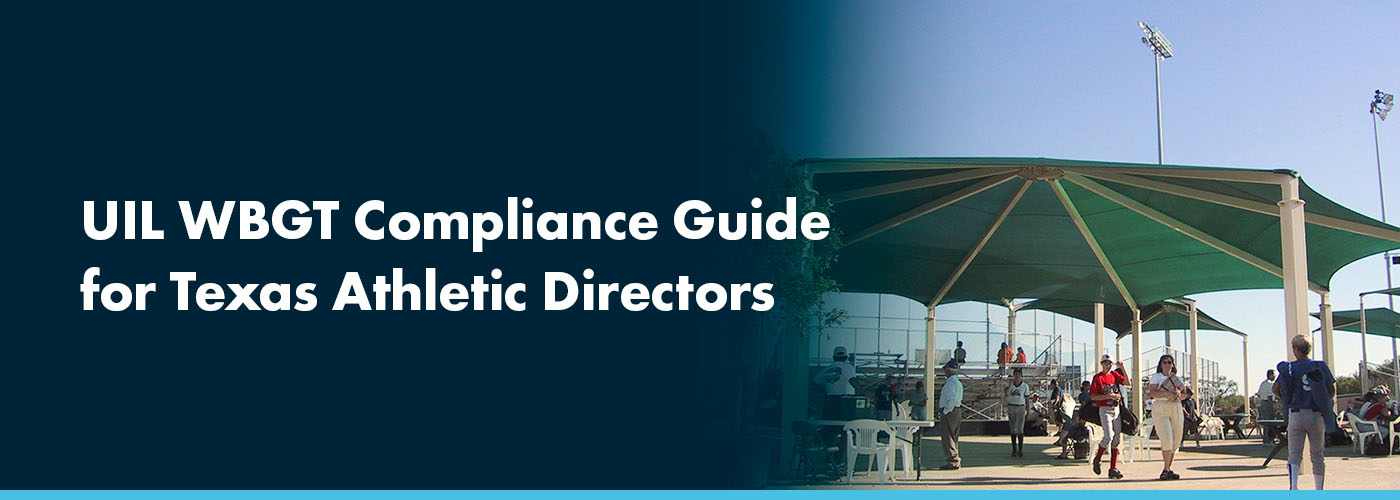
Texas athletic directors have a new active mandate to comply with this season. As of Aug. 1, 2026, every outdoor practice, contest, workout and marching band rehearsal falls under these Texas UIL heat guidelines.
Wet-bulb globe temperature is now the UIL’s required measurement standard for outdoor activities across your program. That single change touches how your staff monitors conditions, documents readings and responds when thresholds shift.
This guide walks through activity thresholds, daily monitoring steps, cooling zone obligations, documentation and the facility-level decisions.
What the UIL WBGT Mandate Now Requires
WBGT monitoring became a required standard beginning with the 2026-2027 school year, but that change didn’t happen overnight. Starting in 2023, UIL member schools spent two seasons voluntarily testing WBGT, giving districts real-world data to work from rather than a theoretical policy.
On the heels of those two successful years of recommended implementation, plus ongoing medical research and national best practices, the UIL’s medical advisory committee recommended the mandate, which its legislative council then approved.
WBGT is a more comprehensive measurement because a single reading factors in humidity, radiant heat and wind speed, giving your staff a fuller picture of how conditions feel on a practice field. The newly introduced requirement covers every outdoor athletic and marching band activity at UIL member schools, including practices, contests, workouts and conditioning sessions.
Class 2 vs. Class 3 — Know Your School’s WBGT Thresholds
Texas splits schools into two UIL WBGT classification zones, and knowing which zone applies to your school determines which thresholds your program must follow this season. Class 2 covers West Texas and the Panhandle. Class 3 covers the rest of the state, reflecting the different humidity profiles each region experiences.
Using an online forecasting tool is the easiest way to input your exact practice location and select the matching classification. Schools located near the Class 2 and Class 3 boundary should make local determinations, consistently apply them for the rest of the year and communicate that choice to their district’s executive committee.
The five activity tiers, drawn from UIL’s activity guidelines, break down by class like this:
| Flag Level | Class 2 WBGT | Class 3 WBGT |
|---|---|---|
| Green | Below 79.7° F | Below 82° F |
| Yellow | 79.7° to 84.6° F | 82° to 86.9° F |
| Orange | 84.7° to 87.6° F | 87° to 90° F |
| Red | 87.7° to 89.7° F | 90.1° to 92° F |
| Black | 89.8° F and above | 92.1° F and above |
While activity modification guidelines only apply to outdoor practices and workouts, cooling zone requirements also extend to contests held outside — a distinction worth remembering as your program builds its response plan.
Daily WBGT Compliance
WBGT monitoring forms the operational core of this mandate, and your athletic director or another designated staff member is responsible for implementing it before and during every outdoor session. For reference, here’s a practical example of a sequence.
- Confirm your classification: Your school’s Texas UIL WBGT class determines every threshold governing your program. Verify it before the season starts.
- Set up early if using a device: Heat stress monitor WBGT devices need about 30 minutes to acclimate to conditions. Set it up well before practice begins.
- Take your first reading on time: Pull the first reading within 15 minutes of starting practice using an on-site instrument or an approved internet-based WBGT application.
- Take readings every half-hour: While UIL doesn’t mandate continuous monitoring, programs must log WBGT at 30-minute intervals. Folding those checks into your practice routine is the easiest way to remain compliant.
- Respond judiciously, not reflexively: When WBGT moves from one tier to the next, apply the UIL’s guidelines to make responsible activity modifications rather than reacting to every incremental change.
- Document every reading: You will need a paper trail to demonstrate your program’s compliance. Keep this written record on file.
- Be consistent: Appointing one staff member to take every reading during a session builds consistency into your data.
- Adjust for covered or indoor spaces: Use a handheld device to measure the practice surface under covered pavilions or in non-climate-controlled indoor spaces.
Rapid Cooling Zones and Emergency Action Plans — The Nonnegotiables
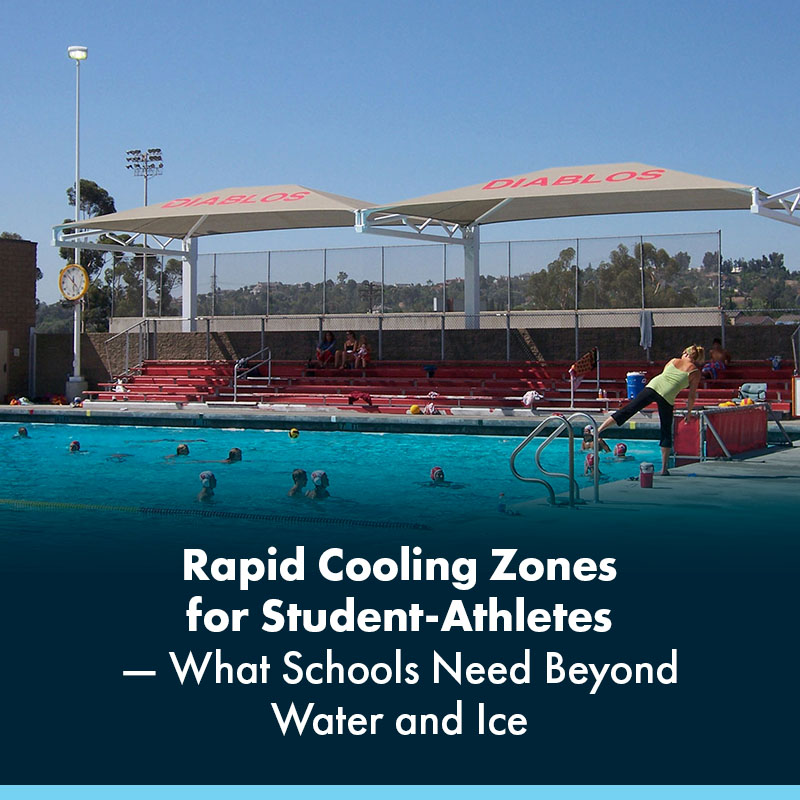
Two requirements of the mandate are compulsory — rapid cooling zones and updated emergency action plans. Since each component addresses the same risk from a different angle, fulfilling them will create a combined response and prevention plan.
When Are Rapid Cooling Zones Mandatory?
A rapid cooling zone is essential for outdoor athletic and marching band activities once the WBGT reaches 79.7° F for Class 2 schools or 82° F for Class 3 schools. Unlike activity modification guidelines, which apply only to practices, this requirement also affects contests held outdoors.
Under UIL rules, a rapid cooling zone must provide total-body cooling via one of two methods — an ice bath or tarp-assisted cooling.
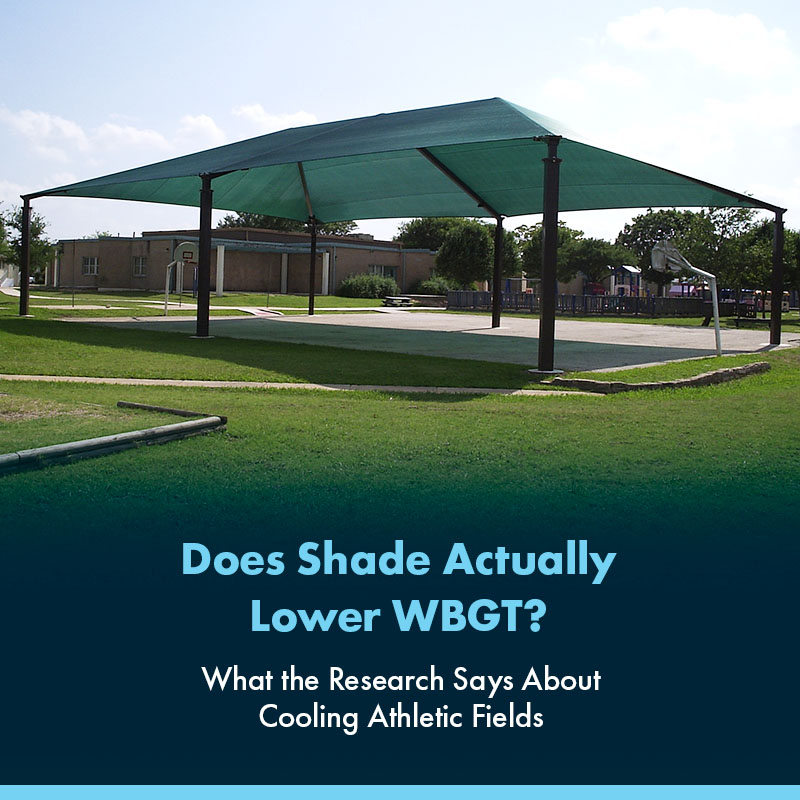
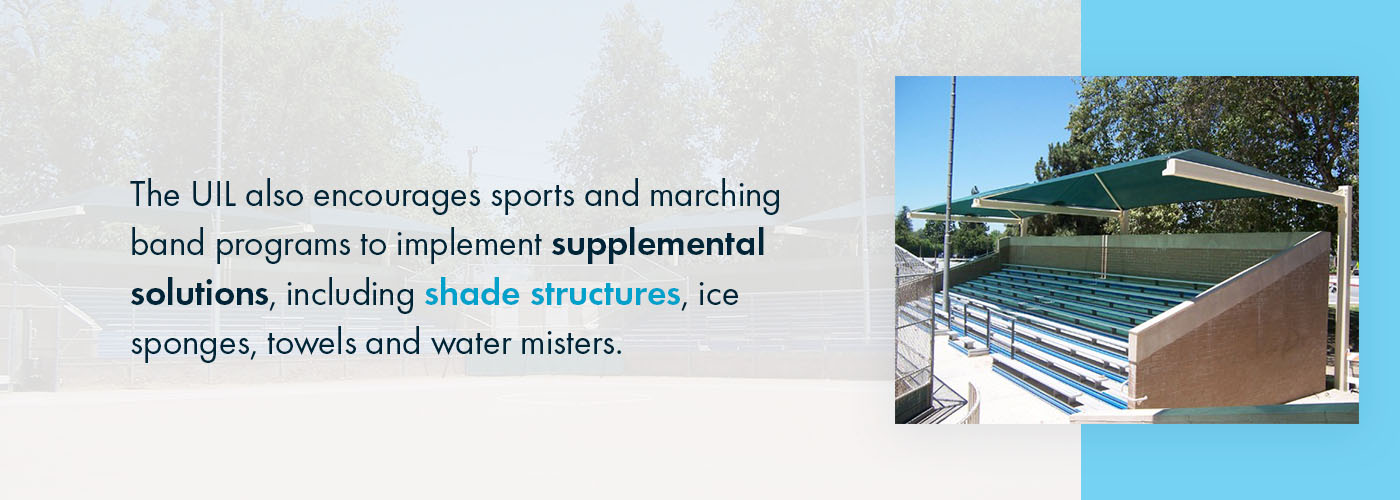
The UIL also encourages sports and marching band programs to implement supplemental solutions, including shade structures, ice sponges, towels and water misters. These methods complement this standard but can never replace it.
What Your Emergency Action Plan Must Now Include
This update targets a specific shortfall in your existing emergency action plan rather than calling for a full rewrite. Your plan now needs guidelines for identifying heat illness, initiating emergency medical services when appropriate and providing on-site, rapid cooling via cold-water immersion or an equivalent method.
Research from the Korey Stringer Institute supports CWI as the gold-standard treatment for exertional heatstroke. These updated requirements apply equally to athletics and marching band programs, so your documentation should include both groups of students without treating either as secondary.
Facility Infrastructure That Supports Long-Term UIL Compliance
Can a school’s physical infrastructure reliably meet UIL obligations for cooling zones, emergency action plans and daily WBGT monitoring, rather than scrambling each time conditions shift?
Permanent shade structures answer part of that question. Sidelines, practice fields and cooling zone areas all benefit from a facility-ready environment built around fixed shade rather than gear your staff hauls out and packs away daily. UIL’s cooling zone language explicitly names shade as an encouraged supplement, aligning this choice with the compliance work your program already handles.
A permanent structure also offers a different value proposition than temporary fixes when a school budget is in the conversation. One-time installation costs replace the recurring expense of pop-up canopies or seasonal equipment. Also, shade structures designed to reduce heat can lower surface and ambient temperatures in the areas your program relies on most, including contests. For a closer look at how these structures fit specific fields and facilities, athletic facility shade structure solutions cover layouts designed for schools undertaking this kind of planning.
Work With USA SHADE on Your Texas Athletic Facility
Fulfilling the UIL mandate requires infrastructure that holds up season after season. USA SHADE has spent over 30 years designing and installing permanent shade structures for Texas schools and athletic facilities, so the new rules are familiar ground for this experienced team.
Let USA SHADE’s design experts walk your school through what shade structure best fits your layout, budget and compliance needs, then shepherd your entire project, from design to installation, under the same roof.
Explore shade structures for schools or browse our Texas shade structure projects already underway. Ready to talk specifics? Speak to an expert and start the conversation.